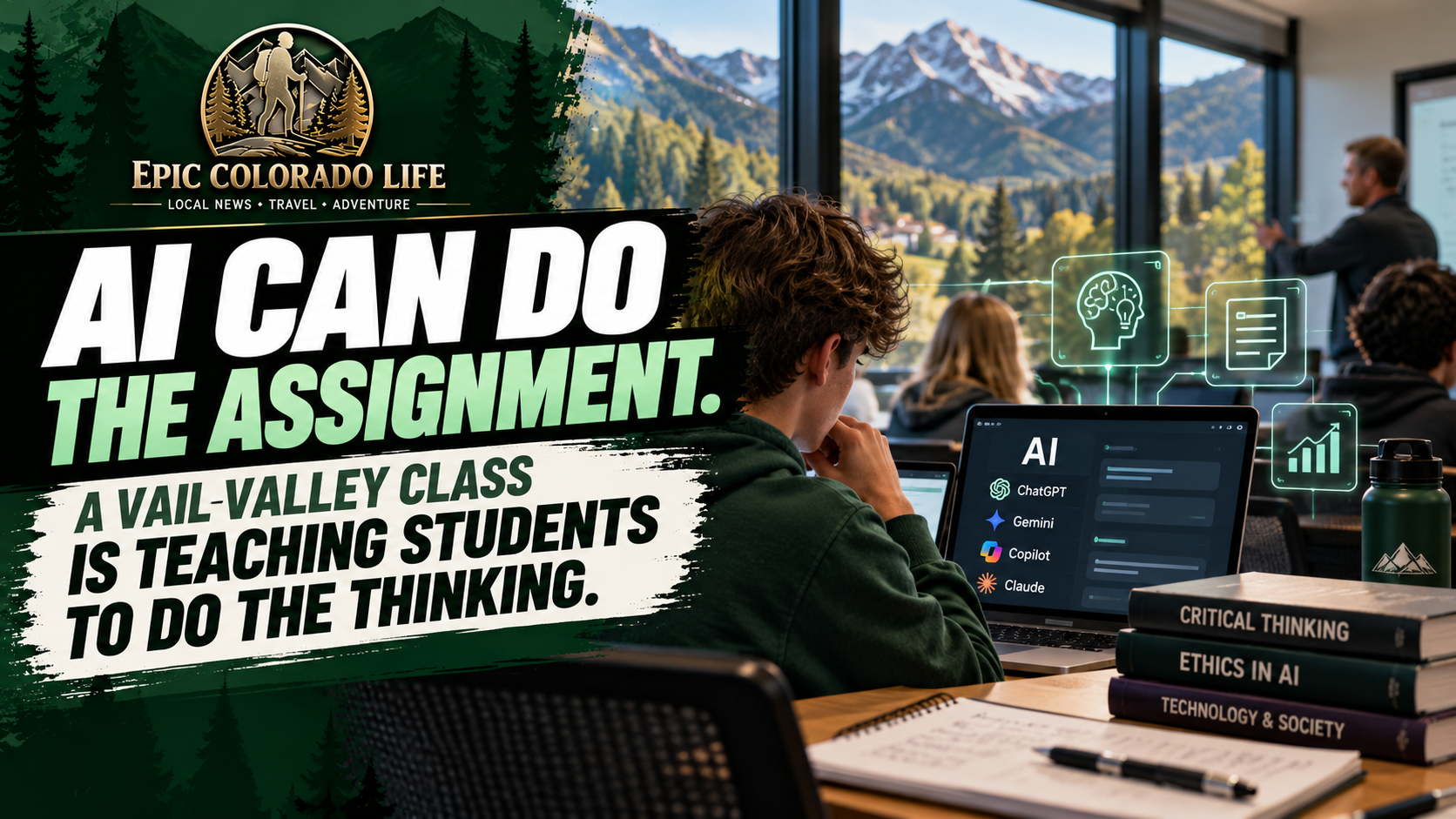
When a chatbot can produce an answer, what should a student still be responsible for?
At Vail Christian High School, a semester-long Principles of AI course is tackling that question through hands-on work with AI systems and discussion of their limitations, according to an October 11 report by the Vail Daily’s Kate Kampner.
The course is taught by Jim Pyke, whom the school lists as a computer science teacher and IT support staff member. Source: Vail Christian’s faculty directory
Learning to use the tools—and question the output
Kampner reported that students work with ChatGPT, Gemini, Copilot and Claude, practicing how to give instructions and evaluate what the systems produce.
The distinction is between getting assistance and surrendering responsibility for the work. Pyke told the Vail Daily that he wants students to retain the critical thinking and problem-solving involved in an assignment.
That makes the class relevant beyond students planning technology careers. Evaluating an answer, checking its accuracy and deciding whether it is useful remain human tasks.
The concern about cheating is part of the discussion
According to Kampner’s report, some faculty initially questioned whether teaching students to use AI more effectively could also help them cheat.
Pyke’s approach is to teach responsible use of a technology students can already access. The course also considers potential harms, with a lesson on misleading deepfakes among the topics described in the report.
The class should not be read as blanket permission to use AI on every school assignment. The published reporting does not establish the rules for every teacher or course.
What students say they are learning
The Vail Daily interviewed three seniors whose experiences illustrate different parts of the course.
Riley Mayer emphasized that AI can be wrong. Jack O’Shaughnessy described using it to help build a website while recognizing the need to manage and check its work. Wyatt Colby said the course helped him understand developments in the technology.
Those accounts point to a practical measure of AI literacy: can a student explain, check and take responsibility for the result?
Three questions worth bringing home
For families discussing AI and schoolwork, this class offers a starting point:
- What does the teacher permit for this particular assignment?
- Can the student explain the answer without relying on the chatbot?
- What did the student independently check before submitting the work?
These are suggested conversation prompts, not a statement of Vail Christian’s schoolwide policy.
The local story is about preparing students to make decisions about a tool they are likely to encounter. Producing an answer is one skill. Knowing whether to trust it is another.
Read Kate Kampner’s reporting in the Vail Daily.
Image credit: AI-generated illustration accompanying coverage of Vail Christian’s Principles of AI course. The people and classroom pictured are fictional.