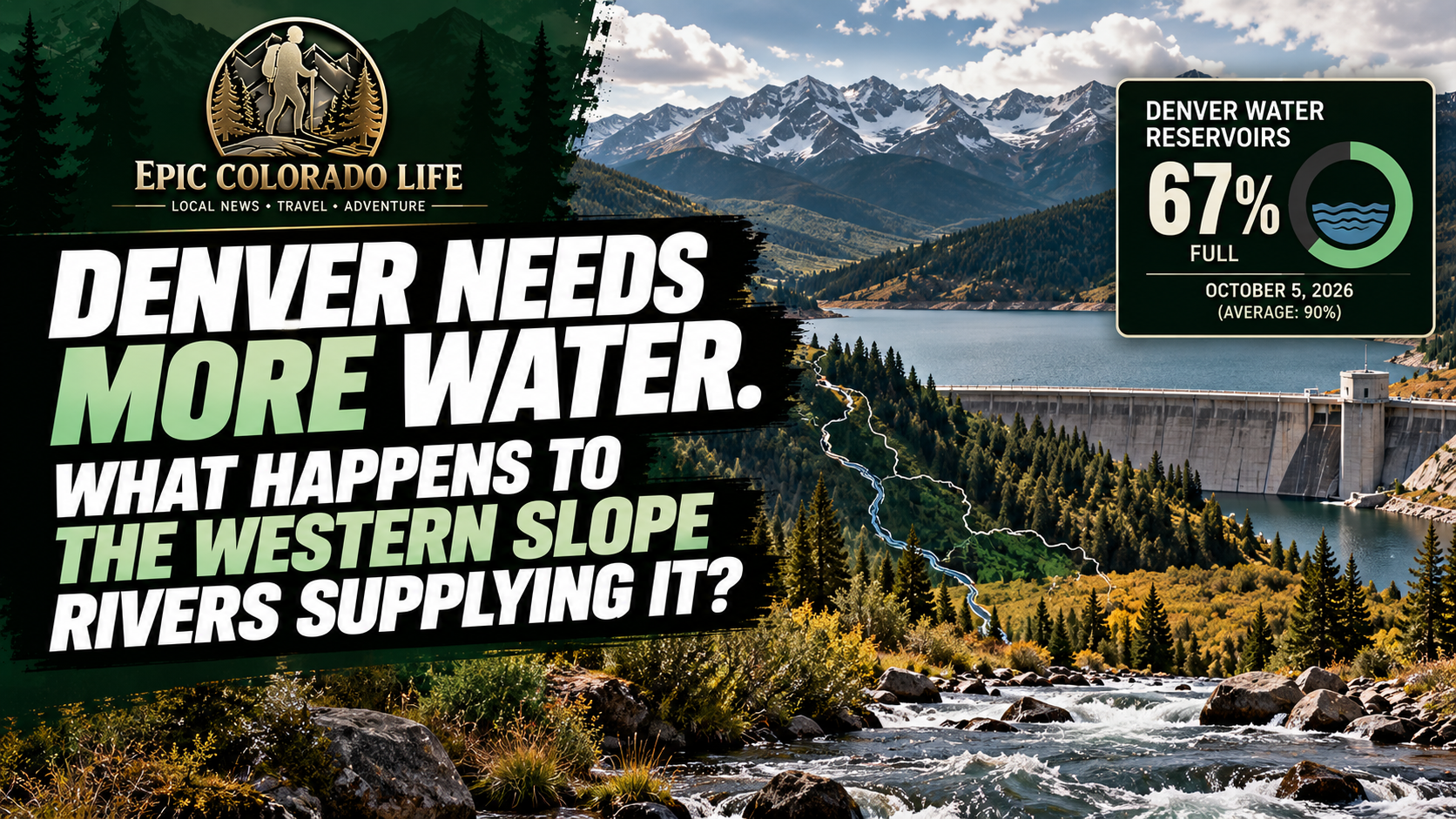
Denver Water’s reservoirs need replenishing before next spring. In Grand County, that means a pressing question: how much water will remain in the streams supplying them?
The utility’s reservoirs were 67% full on October 5, compared with an average of 90% for that time of year, according to its official water-supply update. Denver Water serves about 1.5 million people in Denver and surrounding suburbs. Source: Denver Water
Now, additional diversions from the Fraser River watershed are raising concerns about winter stream conditions, community supplies and fish habitat.
What is changing in Grand County?
In an October 12 report, The Colorado Sun’s Shannon Mullane described planned reductions in the water left flowing past Denver Water’s diversion structures.
The reported changes include a reduction from approximately 4 cubic feet per second to 2 at a Fraser River monitoring location beginning October 13. Vasquez Creek was also scheduled to fall from 3 to 2 cubic feet per second.
These figures describe specific locations and operations. They do not mean the entire Fraser River’s flow will be cut in half.
Mullane reported that Ranch Creek had already dropped from 2 to 1.5 cubic feet per second on October 2. A reduction on St. Louis Creek was expected after agricultural irrigation ended for the season. Read The Colorado Sun’s reporting
Why the water left behind matters
Water that continues downstream past a diversion is often called a bypass flow. For communities near the headwaters, it helps sustain the river through a season when freezing becomes another concern.
Kirk Klancke, president of Trout Unlimited’s Colorado River headwaters chapter, told The Colorado Sun that very shallow winter flows could threaten fish eggs and the aquatic organisms fish depend on.
The Sun also reported concerns about municipal supplies and the amount of stream water available to dilute treated wastewater. These were concerns about potential consequences, rather than confirmation that those consequences had already occurred.
Negotiations changed the plan
According to The Colorado Sun, an initial proposal would have reduced flows on the four streams to 1 cubic foot per second. Discussions between Denver Water and Grand County interests resulted in higher flows than that proposal.
That compromise is an important part of the story. The dispute involves both the needs of a large water system and the communities and ecosystems where some of its water originates.
How conservation fits into the picture
Denver Water declared a Stage 1 drought response on March 25, seeking a 20% reduction in water use. Its October 5 update confirmed that a ban on lawn watering and spray irrigation took effect October 1.
The utility reported an immediate response: average daily consumption during the first few days of October was about 24% below the daily average during the final week of September. That is a short-term comparison, not a measure of the entire summer’s conservation performance. Source: Denver Water’s October 5 update
What this means for Eagle County readers
The specific stream reductions described here concern Grand County’s Fraser River watershed. They are not an announcement of new restrictions on Eagle County households.
But the regional connection matters. Denver Water’s collection network draws from multiple basins, including the Fraser, Blue and South Platte, illustrating how water demand on one side of the Continental Divide can affect supplies on the other. Source: Denver Water’s collection-system explanation
For Western Slope readers, the question extends beyond reservoir percentages: how will Colorado balance stored water for next spring with the flowing water mountain communities need this winter?
Image credit: AI-generated illustration, not a photograph of a specific reservoir or river. Denver Water reported its reservoir system was 67% full on October 5, 2026, compared with a 90% average.